Performance Costs of KDB+ Attributes

In my previous blog, we explored how the four KDB+ attributes - sorted, unique, parted, and grouped - can significantly improve query performance by enabling optimised search and aggregation strategies. However, these performance gains are not without cost.
In this blog, we shift focus from performance gains to the performance costs associated with using attributes — specifically, their time and memory overheads. While attributes can make queries faster, they can also introduce additional processing during data updates or loading, and consume extra memory to maintain internal indexing structures such as hash maps.
Through a series of targeted benchmarks and experiments, we’ll measure these overheads and derive practical models to help you predict the trade-offs. Whether you’re building real-time systems or managing large volumes of historical data, understanding the full cost profile of attributes is key to making informed design decisions in KDB+.
Note
Results were generated using Q/KDB+ version 4.1 (2025.04.28).
Complexity
Firstly, there’s increased complexity in managing attributes. Certain list operations can remove an attribute, requiring developers to explicitly reapply it afterward. Failing to do so may result in unexpected performance regressions. It’s essential to be aware of such cases and apply proper safeguards.
More on attribute preservation is available in my previous blog post.
Time Overhead
In addition to logical complexity, there’s a time cost involved when applying or maintaining attributes.
Applying Attributes
Applying an attribute for the first time involves validation and setup work:
- sorted, unique, and parted must verify order or uniqueness.
- unique, parted, and grouped require the creation of internal hash maps, which grow in size with the list.
To quantify this, we apply each attribute to a list created using til N and measure the average time taken:
| List Count | Sorted (ms) | Unique (ms) | Parted (ms) | Grouped (ms) |
|---|---|---|---|---|
| 1,000 | 0.000429 | 0.0246 | 0.0586 | 0.0868 |
| 10,000 | 0.000291 | 0.234 | 0.556 | 0.965 |
| 100,000 | 0.000412 | 3.33 | 9.77 | 16.1 |
| 1,000,000 | 0.000438 | 38.5 | 86.5 | 155 |
| 10,000,000 | 0.000306 | 604 | 1100 | 1610 |
| 100,000,000 | 0.000796 | 8630 | 15600 | 28100 |
These results show:
- sorted is very fast to apply even for large lists.
- unique, parted, and especially grouped take significantly more time, due to the hash map construction.
We repeat the test on lists of non-unique values, created using N?N div 4, to see how this affects performance:
| List Count | Sorted (ms) | Parted (ms) | Grouped (ms) |
|---|---|---|---|
| 1,000 | 0.000352 | 0.00540 | 0.0247 |
| 10,000 | 0.000335 | 0.0708 | 0.252 |
| 100,000 | 0.000329 | 1.13 | 3.00 |
| 1,000,000 | 0.000542 | 11.9 | 24.8 |
| 10,000,000 | 0.000610 | 304 | 457 |
| 100,000,000 | 0.000357 | 2920 | 4590 |
For a non-unique list, applying parted and grouped is faster — likely due to fewer unique keys, leading to smaller hash maps and lower memory requirements.
Note
If attributes are applied once at system start-up, these times are usually negligible. But, if attributes must be reapplied repeatedly — such as after frequent modifications — they can introduce real overhead.
Maintaining Attributes
If you append to a list with an existing attribute and preserve the required structure (e.g., sorted order), the attribute is retained. However, maintaining it still incurs a performance cost, especially due to structure checks and hash map updates.
We measure the average append time over multiple appends, where each append added 1,000 elements until the list reached 100 million elements.
| Attribute | Average Append Time (ms) |
|---|---|
| None | 0.0102 |
| Sorted | 0.0117 |
| Unique | 0.323 |
| Parted | 0.0119 |
| Grouped | 0.680 |
The test was also repeated for 100,000 elements appends.
| Attribute | Average Append Time (ms) |
|---|---|
| None | 0.648 |
| Sorted | 1.08 |
| Unique | 44.8 |
| Parted | 0.987 |
| Grouped | 84.5 |
These results show that:
- Grouped and unique are most expensive to maintain during appends, largely due to hash map maintenance and uniqueness checks respectively.
- Larger appends incur a larger time cost.
Space Overhead
In addition to time costs, attributes (except for sorted) also introduce space overhead.
The unique, parted, and grouped attributes each maintain an internal hash map to support fast access, which increases memory usage. The size of this overhead depends on the list count and/or the count of unique elements.
To measure this overhead, we use the following procedure:
- Create a list.
- Save it to disk.
- Record the file size using
hcount. - Apply the attribute.
- Record the new file size using
hcount. - Subtract the original size to calculate the overhead.
Unique
The overhead introduced by the unique attribute depends solely on the count of the list, regardless of the data values.
We measured this by applying the unique attribute to lists of increasing count (1 to 10,000 elements), and plotted the results:
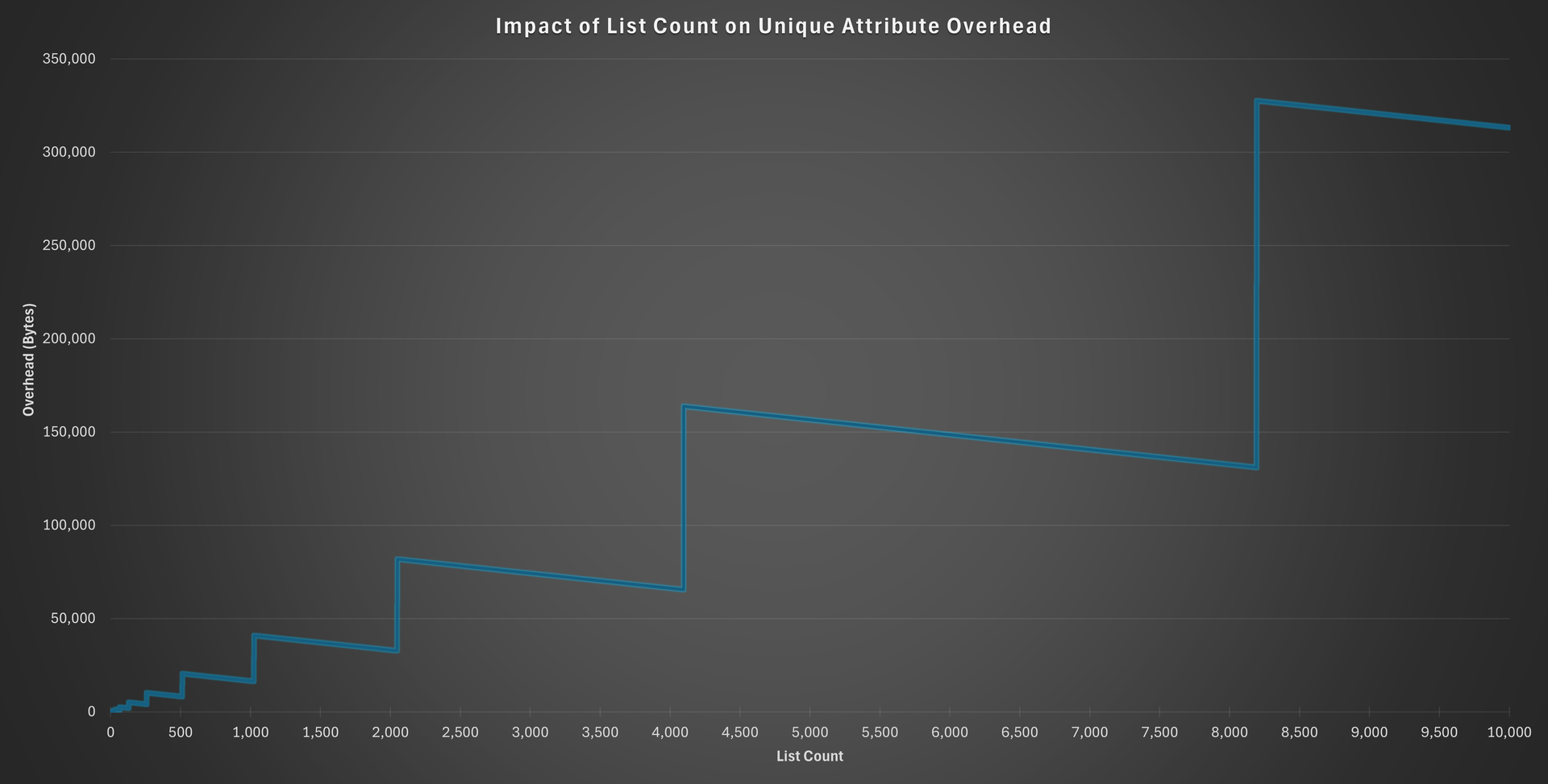
The resulting step-wise growth pattern occurs because KDB+ uses a buddy memory allocation system. When the current memory block is insufficient for the hash map, the system allocates a new block twice as large, causing jumps in overhead.
Interestingly, within each step, the overhead decreases linearly as list count increases — likely due to more efficient packing of the hash structure relative to the allocated memory.
A portion of the data is shown below:
| List Count | Overhead (Bytes) |
|---|---|
| 0 | 0 |
| 1 | 16 |
| 2 | 32 |
| 3 | 72 |
| 4 | 64 |
| 5 | 152 |
| 6 | 144 |
| 7 | 136 |
| 8 | 128 |
| 9 | 312 |
| .. | .. |
| 16 | 256 |
| 17 | 632 |
| .. | .. |
Deriving a Formula
To generalise the memory overhead of the unique attribute, we begin by defining p as the next power of 2 greater than or equal to the list count n:
\[ p = 2 ^ {\lceil \log_{2}{n} \rceil} \]
From the observed data, we note that whenever the list count n is an exact power of 2 (e.g., 1, 2, 4, 8, 16…), the overhead aligns with:
\[ \text{overhead} = 16n \quad \text{where} \space \space n = 2^k, \space \space k \in \mathbb{Z}_{\ge 0} \]
This gives us the base overhead at each power-of-2 boundary. Between those boundaries — that is, for values of n such that \(n \in (p/2, p)\) — the overhead decreases by 8 bytes for every step closer to p. This decreasing pattern suggests the adjustment term:
\[ 8(n - p) \]
To express the general formula for any list count n, we substitute the fixed power-of-2 overhead (16n) with 16p, since p is the power of 2 the list will eventually “grow into”. Applying the adjustment term, the formula becomes:
\[ \begin{align*} \text{overhead} &= 16p - 8(n - p) \\ &= 8(3p - n) \end{align*} \]
This can be computed in Q with:
nextPower2:{[n] "j"$2 xexp ceiling 2 xlog n}

uniqueOverhead:{[n] 8*(3*nextPower2 n)-n}
Example usage:
q)uniqueOverhead 1+til 10
16 32 72 64 152 144 136 128 312 304
Parted
The overhead of the parted attribute depends primarily on the count of unique elements in the list. This is because the internal hash map stores each unique value along with the index of its first occurrence.
To analyse this, we tested 10,000-element lists with varying counts of unique values, from 1 to 10,000.
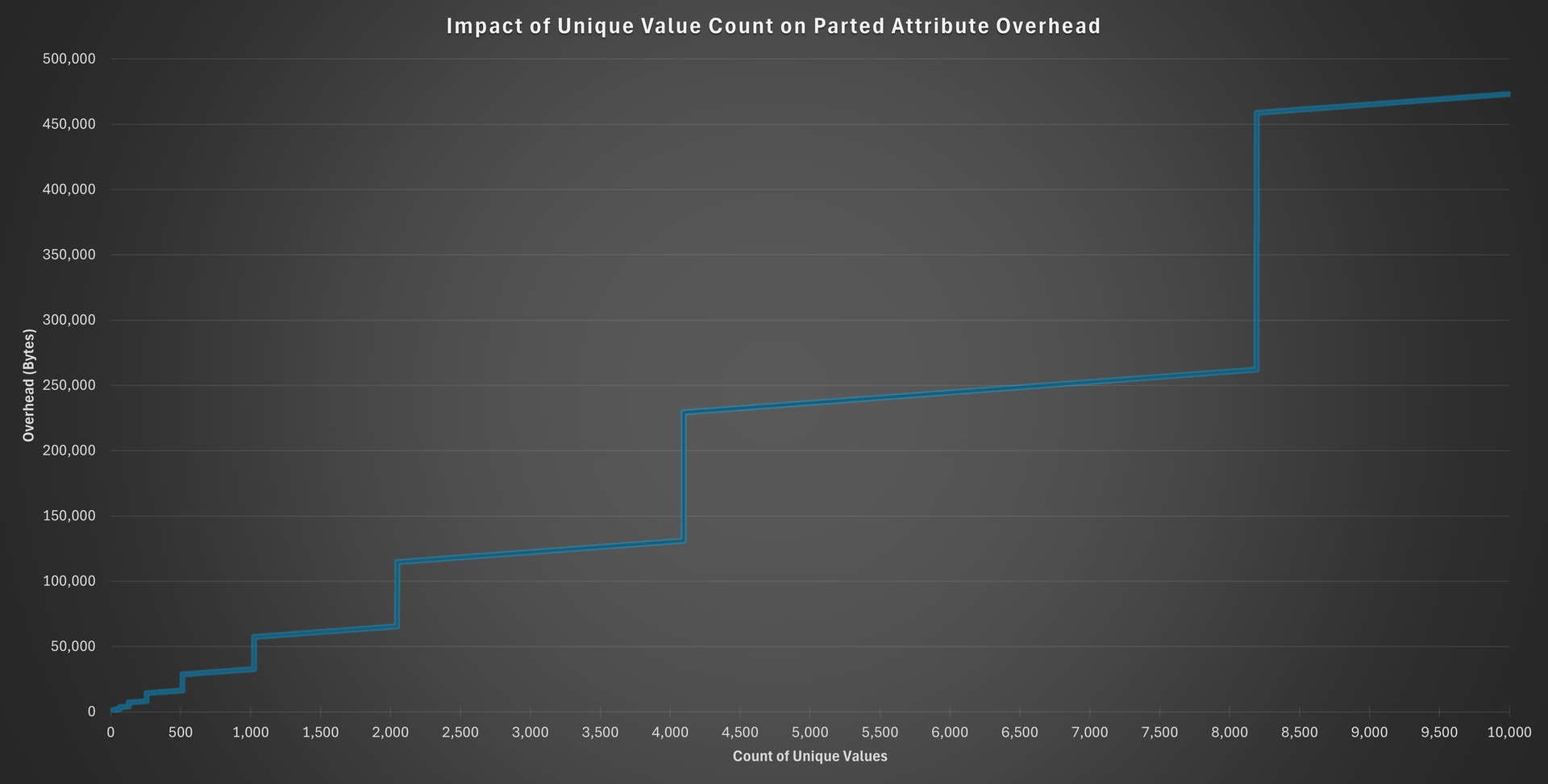
As with the unique attribute, we observe a step pattern, which results from KDB+ allocating memory in powers of 2 (buddy allocation system).
Between each step, the overhead increases linearly with the count of unique values.
A portion of the results is shown below:
| Count of Unique Values | Overhead (Bytes) |
|---|---|
| 1 | 72 |
| 2 | 104 |
| 3 | 160 |
| 4 | 168 |
| 5 | 272 |
| 6 | 280 |
| 7 | 288 |
| 8 | 296 |
| 9 | 496 |
| .. | .. |
| 15 | 544 |
| 16 | 552 |
| 17 | 944 |
| .. | .. |
From this table, we see that at powers of 2 (1, 2, 4, 8, 16), the overheads are:
u:           1  2   4   8   16
overhead:    72 104 168 296 552
Subtracting a constant base of 40 bytes (likely fixed overhead for the hash structure) gives:
32, 64, 128, 256, 512 = 32 × (1, 2, 4, 8, 16)
This suggests the overhead at powers of 2 follows:
\[ \text{overhead} = 40 + 32p \]
where
\[ p = 2 ^ {\lceil \log_{2}{u} \rceil} \]
and u is the count of unique values in the list.
General Formula
For non-power-of-2 u, we observe that the overhead increases by 8 bytes with each additional unique value until the next power-of-2 threshold. This incremental cost can be modelled as:
\[ 8(u - p) \]
Putting it all together, the complete formula becomes:
\[ \begin{align*} \text{overhead} &= 40 + 32p + 8(u - p) \\ &= 8(3p + u + 5) \end{align*} \]
In Q, it can be implemented as:
partedOverhead:{[u] 8*5+u+3*nextPower2 u}
Example:
q)partedOverhead 1+til 10
72 104 160 168 272 280 288 296 496 504
Grouped
The overhead of the grouped attribute depends on both the total count of the list (n) and the count of unique values (u). Internally, KDB+ builds a hash map that stores each unique value along with the indices of all its occurrences in the list, which explains this dual dependency.
To measure the overhead, we tested lists of 10,000 and 20,000 elements with varying counts of unique values. For comparability, the 20,000-element list was tested only up to 10,000 unique values.
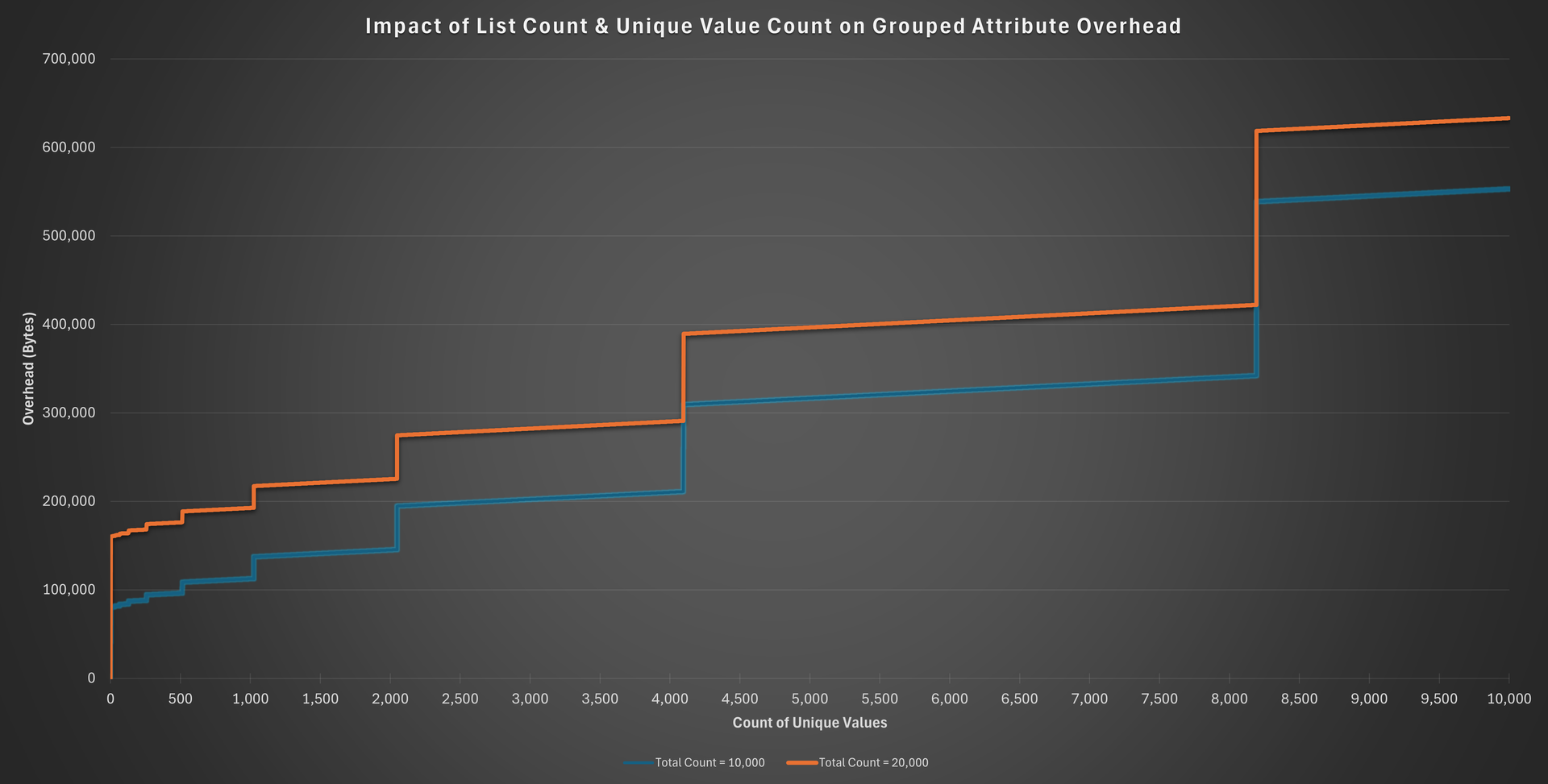
The chart shows two lines — one for each total list count. For a given count of unique values, the larger list incurs higher overhead, confirming that the grouped attribute scales with both list count and the count of unique elements.
Analysing the Overhead
Let’s look at a small snippet of the results for each total list count.
Snippet for List Count = 10,0000
| Count of Unique Values | Overhead (Bytes) |
|---|---|
| 1 | 80,088 |
| 2 | 80,120 |
| 3 | 80,176 |
| 4 | 80,184 |
| 5 | 80,288 |
| 6 | 80,296 |
| 7 | 80,304 |
| 8 | 80,312 |
| 9 | 80,512 |
| .. | .. |
| 15 | 80,560 |
| 16 | 80,568 |
| 17 | 80,960 |
| .. | .. |
At powers of 2 (1, 2, 4, 8, 16), we observe the following overheads:
u:         1       2       4       8       16
overhead:  80,088  80,120  80,184  80,312  80,568
Subtracting 80,056 from these values gives:
32, 64, 128, 256, 512 = 32 × (1, 2, 4, 8, 16)
This suggests that for power-of-2 u, the overhead is:
\[ \text{overhead} = 80,056 + 32𝑝 \]
We’ll revisit the 80,056 in a moment.
Snippet for List Count = 20,0000
| Count of Unique Values | Overhead (Bytes) |
|---|---|
| 1 | 160,088 |
| 2 | 160,120 |
| 3 | 160,176 |
| 4 | 160,184 |
| 5 | 160,288 |
| 6 | 160,296 |
| 7 | 160,304 |
| 8 | 160,312 |
| 9 | 160,512 |
| .. | .. |
| 15 | 160,560 |
| 16 | 160,568 |
| 17 | 160,960 |
| .. | .. |
Again, for powers of 2:
u:        1        2        4        8        16
overhead: 160,088  160,120  160,184  160,312  160,568
Subtracting 160,056 yields the same \(32 × p\) pattern
Interpreting the Base Overhead
Notice that:
- For the 10,000-element list, the offset was 80,056
- For the 20,000-element list, it was 160,056
This suggests the base overhead grows linearly with the list count. Specifically:
\[ \begin{align*} 80,056 &= 56 + 8 × 10,000 \\ 160,056 &= 56+8×20,000 \end{align*} \]
So, the general base overhead is:
\[ base = 56 + 8n \]
where n is the total count of the list, and 56 is likely a fixed base cost for the internal structure.
General Formula
For non-power-of-2 u, we again see 8-byte increments per unique value until the next power-of-2 is reached. Thus, the total overhead can be expressed as:
\[ \begin{align*} \text{overhead} &= 56 + 8n + 32p + 8(u - p) \\ &= 8(3p + n + u + 7) \end{align*} \]
Where:
- n is the list count.
- u is the count of unique values.
- p is the next power of 2 greater than or equal to u.
Q Implementation
groupedOverhead:{[n;u] 8*7+n+u+3*nextPower2 u}
Examples:
q)groupedOverhead[10000;] 1+til 10
80088 80120 80176 80184 80288 80296 80304 80312 80512 80520

q)groupedOverhead[20000;] 1+til 10
160088 160120 160176 160184 160288 160296 160304 160312 160512 160520
Note
The formulas derived for computing attribute overheads are based on the current internal implementation of KDB+. As such, they may change in future versions if the underlying architecture is modified. However, the methodology used to derive these formulas — through systematic measurement and pattern analysis — can still be applied to recalculate overheads if needed. The approach is general and remains valid even if the specific outcomes evolve over time.
Conclusion
While KDB+ attributes offer powerful query optimisations, we have shown that these benefits come with measurable costs in time and memory.
We’ve seen that attributes like unique, parted, and grouped maintain internal data structure — typically hash maps — that vary in size depending on both the total count of the list and the count of unique values. This leads to non-trivial memory overhead, which can scale into hundreds of megabytes or more for large datasets.
We also observed that applying attributes can incur time overhead during operations like loading, writing, or updating data — particularly for attributes that require hashing or maintaining metadata during write time.
The key takeaway is that attributes are not free. Their use should be deliberate and informed. If the expected query performance improvement outweighs the storage and update costs, they can be extremely valuable. But for infrequently queried or write-heavy data, the overhead might not justify their use.
As always with performance tuning, measure before and after, and choose the right tool for the workload.